Edward Gibbon’s The Decline and Fall of the Roman Empire- Review
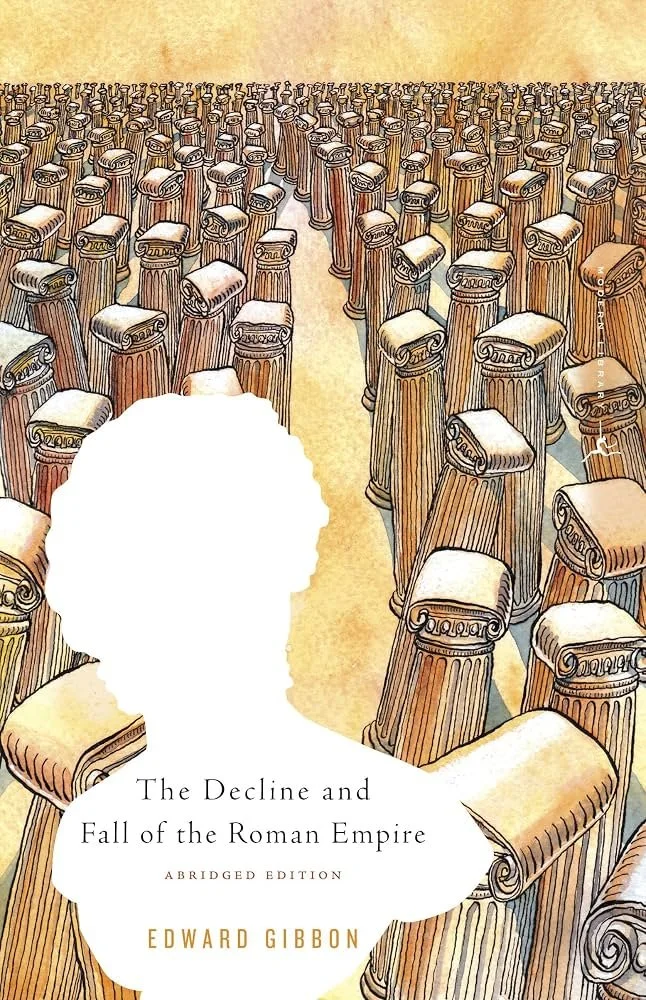
In recent human history, no history text has inspired the questions and imagination of the nations of the West like Edward Gibbon’s The Decline and Fall of the Roman Empire. The beautiful, florid style of Gibbon painted the cultural image we have today and the winding, macroscopic narrative he presents served as a key foundation for the study of Roman history. No doubt many historians today push back on the accuracy of Gibbon’s findings, and by no means are they probably incorrect. This book is hundreds of years old, almost as old as America itself and it would be naive to think it’s still the predominant work of Roman history as far as facts are concerned. But as a narrative and an art work, it still stands high in the pantheon of historical literature. What Gibbon’s work may now lack in strict accuracy is overwritten by the vast epic-ness of his Enlightment era writing style and the distinct, snarky but dramatic flair of his narration. I can’t say this is the best book to read to learn about Rome, but it may be the best overall book that will attempt to be so.
So to start off, let me clarify- there’s not any Julius Ceasar or Brutus in this book, nor will you hear a great deal about classic fixtures like Carthage, Romulus and Remus, the abduction of the Sabines, the conquest of Gaul and the triumphs of figures like the Scipio family or Hannibal. Those are Roman Republic era events and figures, which are all referenced at most. Weirdly, even though we as Westerners fancy ourself as children of the Roman Empire, much of our most storied lore of that Empire is actually from right before, or right after it’s birth from the Roman Republic. Usually the story ends at Augustus, who was a great Emperor who built the critical foundations of the Empire.
Augustus, the heir of Julius Ceasar, defeated Mark Antony, a would be contender for the throne, and is proclaimed Emperor in 27 B.C. We don’t know the exact month because I believe he, like Ceasar before him, invented a new one. He does a bunch of very important work establishing the Empire, working diligently to boost both the respect and love for his position through good governance that set the path for widespread prosperity and security of the Roman people. He’s followed by the other Judo-Claudean emperors, notably Tiberius, Caligula, all the way up to Vitellius, who lost a civil war to Vespasian. Vespasian is a Flavian, which is the name of the next Roman Imperial family and they ruled 27 years before the Antonines took over, starting with Nerva in 98. That’s 98 A.D.
The Age of the Antonines is where we start our tale, in fact it’s the explicit context of the first three chapters. You are delicately dragged through a lush and epic description of the Roman Empire at it’s peak, which stretches through this era called “The Five Good Emperors”, which were Nerva, Trajan, Hadrian, Antoninus Pius, and Marcus Aurelius. At this point, Rome controlled the entirety of modern day Italy, Spain, France, Greece, Palestine, Lebanon, Turkey, the Balkans and some other choice parts of modern day Egypt, Libya, Morocco, Algeria, Tunisia and Britain. It’s actually crazy to think about that reach when you consider the time period and what an empire with those nations would mean today.
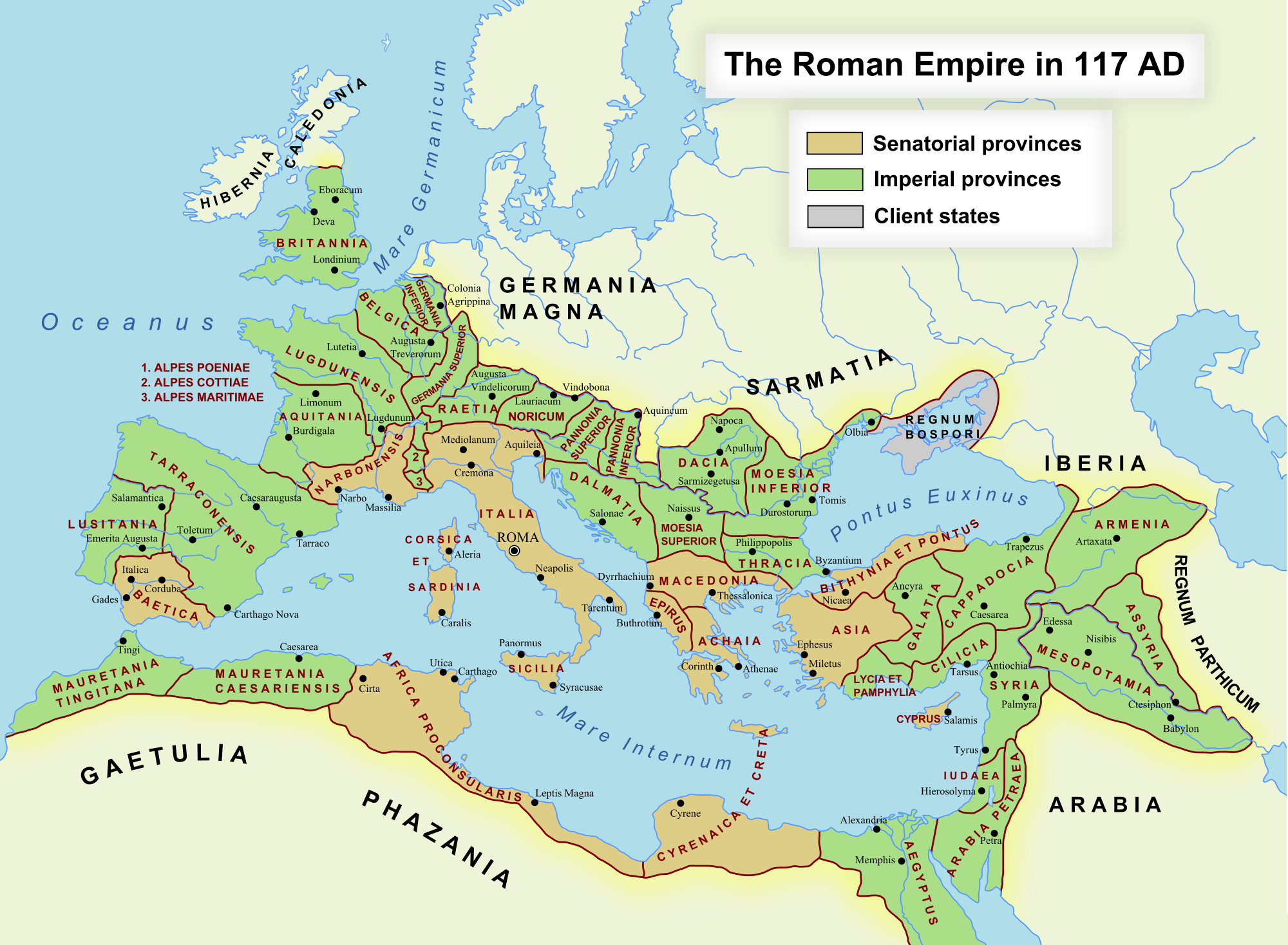
This was the Age of the Antonines and was generally Rome’s territory for the next 200 years afterwards. An empire on three continents, with a massive military, a strong and notably, well resourced, economy. Access to Britain’s tin and African’s grain, as well as the gold of Dacia and silver of Hispatania, cemented the Roman’s dominance over the world economy, such as it was at the time. There have been bigger empires, richer empires and better militaries, but very few, if any, were so well placed both geographically, and in history, so as to influence human development. At this point in time, where our story begins, Rome is at it’s apex.
That’s the thing with this book- it starts with the honeymoon and then moves slowly, then quickly, towards the degeneration and collapse of the Western Empire, whose decline is as awe inspiring as it’s triumphs. We quickly learn the most elementary downfall of empires, which is the possibility of getting a weak or lazy emperor. Figuring out how to build an adminastrative state that could bolster and run a country concurrently with a monarch or ruler hadn’t really been uncovered yet. Nor was the Roman military managed or balanced in such a way as to keep them from simply naming their own Emperor. After this initial prosperity, these flaws are bared and soon it became clear that force was the real ruler of Rome.
The book initially frolics in the prosperity of the peak Romans, but then history takes its course. The emperor Commodus is stabbed while relieving himself and the chaos of the resulting power struggle leads to a rich man named Didius Julianus (strange name I know) literally buying the seat of power. This obviously doesn’t go on for very long, but the damage to the institution of Emperor is done and from here, we move through a series of greedy, bad and ineffective emperors for the most part. The wealth of Rome, so elegantly depicted in the early chapters, ends up being key to the degeneracy that contributed to it’s decline.
The following era is known as the Crisis of the Third Century and it’s, in my opinion, one of the best parts of the book. We get many revolutions, corrupt schemes and military revolts in a roughly 100 year period, some of them ranging from quick coups to long drawn out civil wars. As such, the emperors of this time are very short lived and tend to be military men, notably including Maximinian who was not a general, but a Barbarian.
One of the qualities that makes this book feel so cinematic is it’s scope, but specifically, the way this scope is presented. The book is broken into 6 parts. Typically, the way it works is that you get a chapter or two setting up what the Romans doing, a couple chapters going through the Romans history and then at the end, after a resolution of some kind to whatever sequence the Romans offered, you get a chapter or two of deep exposition and context on a foe or historical progression that will factor into the next part. These typically revolve around either Christian history or the rise of a neighboring or competive power, such as the Arabs, the Turks, the Ottomans, the Mongols, the Barbarians, etc. These are mostly very good chapters, particularly the civilization focused ones.
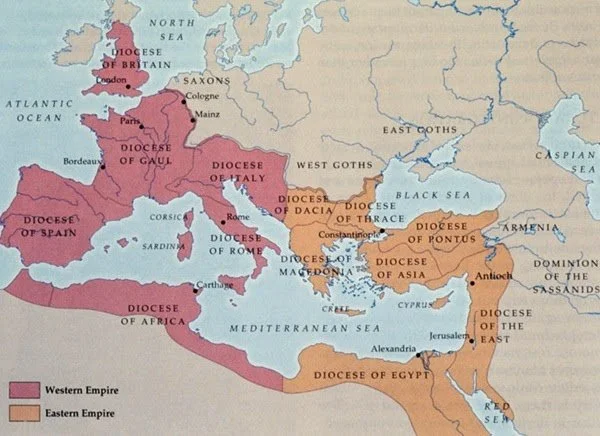
After about the 300 page mark, a meaningful change in the Roman Empire, a sign of what’s possibly to come- the (finally) reunited and stabilized Empire is split into two. We also get the founding of Constantinople, the capital of the East. Located in modern day Turkiye on the Hellespont, Constantinople (Istanbul) quickly becomes a big player in Roman society and we start to see the splintering off of the two cultures, with the Western Roman Empire being more pure “Roman” while the Eastern Roman Empire takes a Greek lean.
Religion also changes here- Christianity slowly but surely overtakes Paganism, and under Emperor Constantine quickly becomes the state religion. Gibbon is often criticized for his take on this situation, as he, a product of the Enlightenment, felt that it did a substantial amount of harm to the Empire and that the petty theological disputes heavily contributed to the Empire’s division and corruption. Is he necessarily right? I’m not one to say but he takes great strides to make his point.
This next 200 years or so has the Empire perilously teetering on the brink of collapse, only to get revived time after time by this Emperor or that Emperor who is just good enough to give them another 20 years or so of float before they continue collapsing. Some notable ones include Diocletion, who actually split the Empire into four piece (it was later reconsolidated and split in two) and Julian, who tried bring Paganism back into the Empire. All and all, these Emperors had very solid runs as leaders and actually did save Rome. It’s just that, in a declining Empire, 20 or so years of improvement is rarely enough to overcome the headwinds of ruin.
We also start to see the Barbarians become a real problem here. 400 years ago, they were technologically underequpped and were pushed back by the Romans relatively easily most of the time. 300 years ago they showed the capability to cause actual problems. Fast forward now to about 400 A.D and the Barbarians are closer to the Romans technologically and organizationally and the fact there’s several large groups of them who constantly pose a threat evolves into a terrifying logistical situation for the Romans.
Gibbon paints this picture well and it’s hard even for the most Roman sympathetic reader to not feel a bit impressed by the advancement of the Barbarians. The cultural detail Gibbon digs into does a lot to make the Barbarians feel more human and less barbarous. You can see strands of the development and cultural exchange that would later lead, way forward in history, to modern Europe.
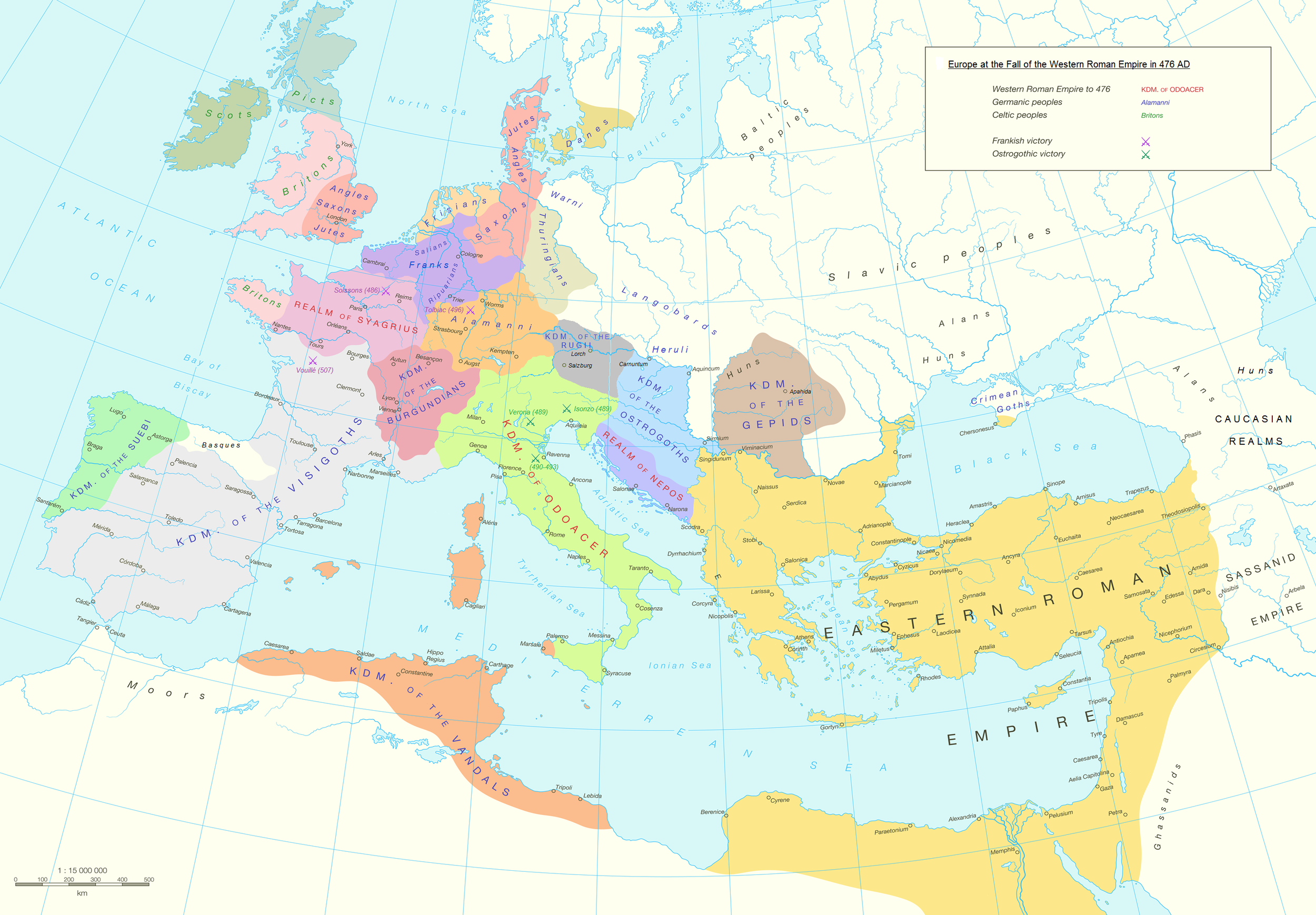
This book is pretty well paced and overall, I think it moves through history efficiently even with all the context it provides. It’s a very rich and detailed read (even if some of it is not perfectly accurate- it’s an old book). However, much like how Gibbon is somewhat biased against Christianity, he also seems a bit biased against the Eastern Roman Empire. This would track as it was much more religious, corrosively so at times. This also corresponds with the Catholic Church becoming a big player in events.
From here on, the book becomes less about Rome itself and more about the development of the early West. The Barbarian kingdoms of Italy and the Franks (later France), as well as the development of the Holy Roman Empire, all run parallel to the plodding struggles of the Eastern Roman Empire. The best days of Rome are far behind it, but it’s influence stills looms large.
Byzantium is a very interesting topic in it’s own right and I think there was definitely meat left on the bone here. It does feel at times like Gibbon simply sprints through important, prosperous eras in Byzantium and focuses more on some of their neighbors. The development of Islam is a huge part of this second half of the book and from here on out, the threats seem to mostly come from the East, either Middle or European.
Though less flashy and less straightforward than the first half, the Byzantium section of this book is extremely rich in it’s own right. Gibbon knows how to dress up an occurrence and while the East Roman Empire may seem underwhelming in some ways, Gibbon excels at tying it into it’s replendent Roman past. The decline of institutions is held up dramatically against the former glories of the Senate of Antiquity, the the failure of arms is snarkily lambasted and the weakness of leadership is coldly and dryly mocked. Gibbon’s slight dislike of the Eastern Roman Empire feeds into the larger narrative of tragedy and disappointment he is weaving.
I really enjoyed this book and think it’s a phenomenal piece of literature. However, anyone buying this should know that, as much as the star of the book seems like Rome, it really is Edward Gibbon. It’s his voice that sets the stage and illustrates the players in such a caustic, cinematic way. He’s snarky, funny, dry and occasionally outright hateful towards the material but it all leads to a brilliant and unique style that brings the history to life. It’s a surprisingly personal style too and I often felt like Gibbon was talking as if he was teaching a single student; the reader.
It’s a big book, an old book and a long book. But if you feel up to it, you will be rewarded. Decline and Fall of The Roman Empire is an experience like no other, even if I wouldn’t recommend it to everyone. It’s journey through history that is often as bleak as it is grandiose. There’s a strong strain of humanity that runs through the entire tale that is just as important as the events taking place. It fits with the broader modern sentiment towards Gibbon, which is that his strongest legacy is as that of a storyteller and writer rather than as a historian. But even if the history is sometimes far from perfect, this book is pivotal to the modern idea of Rome. It’s a piece of Western heritage in of itself that in my eyes, is as relevant as a work of literature as it is a work of history.