Stalin: Court of The Red Tsar-Book Review
We need the full size picture for this.
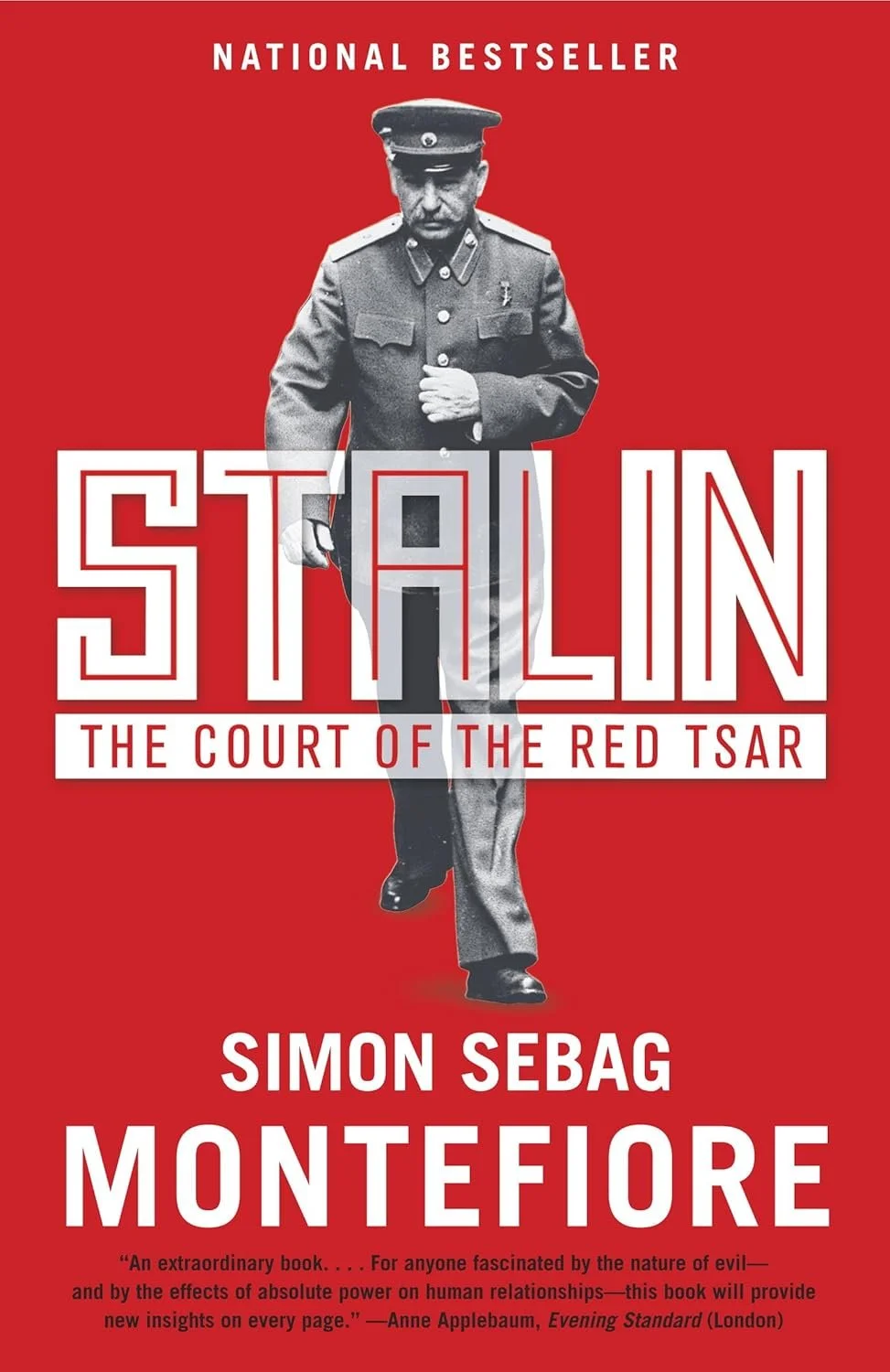
Stalin: Court of The Red Tsar is one of the best history books I’ve ever read, one of the best books I’ve ever read and one of the best portraits of a human being that I’ve come across in my time as a reader. We know the propaganda about Stalin, much of it somewhat true, but we rarely take a closer look. Well this book is a microscope. It takes you into almost every gritty detail we know about Iosef Stalin, a man who’s influence is still felt today all over the world.
“Who can understand our people?” Stalin says exasperated and amused, as a beggar he has just given money to shakes his fist at him. This is a recurring element of the book- Stalin’s inability to understand people, not as peers, but like an old man who has just met a baby zoo animal. He finds them amusing, dumb and ultimately pointless, means to an end that only he can process. Even now many of his actions are still unclear in exact motive or purpose, but the results, regardless of what they were, were often undeniable.
Iosef Stalin was born on the 18th of December, 1875, to a single mother. His father is still a mystery (though we have many theories.) He studied to be a priest for much of his early life, which gave him a basis in literature and writing that other Russian citizens did not have. In fact, Stalin was actually Georgian. He was born closer to Baghdad than Moscow. This would never matter in his life.
He became a passionate socialist and went to prison in Siberia multiple times for running illegal newspapers and just generally being a menace to the established order. Despite being only 5’5-ish, Stalin’s force of will was incredible. He was a street fighter, a callous womanizer, a writer and a voracious reader. He read 200 pages a day his entire life and wrote many books on socialism.
It was only after the Russian Revolution of 1917 that Stalin really began to make his mark. He was already a well respected and renowned Socialist, but when Lenin and Trotsky’s movement took full control of the country, Stalin’s role grew. It is never explicitly said, because we will never quite know, but Stalin, for all his Socialist leanings, was ultimately probably less of a purist than Lenin or Trotsky. He respected and understood the ideals of the movement, but was much more pragmatic than either of them. Lenin felt Germany was the perfect candidate for Socialism and wanted the revolutionary movement to spread across Europe. Stalin…did not feel that way. His calculus was that attempting to spread to other nations in Europe, which were richer, more well equipped militarily and more stable societally, would result in the movement being spread thin and eventually defeated or diluted. After all, they had already seized the largest, arguably most resource rich country in Europe, with a massive, comparatively docile population. Why not stay there and build something instead of leaving it behind and risking losing it?
Lenin’s death in 1924 led to Stalin taking power and the rest is history, all so beautifully written and laid out in this book in a way that it almost feels mythical, Biblical in scale and yet…all too real. It’s 600+ pages and hyper-dense- it blends the writing and style of narrative seamlessly with the matter of fact conducting of historical events. We learn what Stalin did, what other’s say he did, what they thought of it, but we don’t always know why he did it. We can’t interview him. For all the insane detail of Montefiore’s research, there’s still so many questions we can’t answer.
And his research is indeed detailed. We learn things like- what movies Stalin watched and when, specific anecdotes about dinners- month to month, we see his letters to friends and citizens, read his own rumanations and hear all kinds of accounts of his wrath, his cunning and his occasional generosity. There’s an excellent balance of primary, secondary and beyond accounts of events, which serve to raise the mythic status of the known and mysticize the unknown in Stalin’s life. In this way, he emerges from the pages as more than a cut and dry historical figure, but as this complex unknowable force of governance. The many great successes, with occasional failures usurped by luck told throughout the book only serve to further bemuse the reader with the idea that this evil dictator’s empire seems divinely ordained. By what force is the question.
The beginning of this book is absolutely perfect. For one, it quickly acclimates you to Montefiore’s style, which blends density, starkness and scope into something that feels distant, calculated but also cinematic. The icy prisons of Siberia, the harsh Moscow winters, the hopeless battlefield and often aimless, desperate, vengeful meanderings of the Russian people under Stalin are painted with a precision that only accentuates their horror and sadness and emphasizes it’s distance. We start the story in 1933, where an ascendant Stalin, who has successfully industrialized his nation through the Holomodor (a horrendous Ukrainian genocide by starvation), is walking the streets of Moscow on a nice night, headed to a party at the Politburo. He gives a beggar some money, to which the beggar scoffs, prompting a confused and annoyed Stalin to remark “Who can make sense of our people?” to his friend Molotov (of Molotov cocktail fame). From there a dinner party plays out that changed the course of history.
Then we go back- we start at the beginning of Stalin’s life, follow him through childhood, religious school, becoming a Socialist, becoming a prisoner….several hundred pages until he is now the leader of Russia, the Stalin we know. It’s a movings structure which serves to propel the viciousness and brutality of everything that follows from that day in 1933.
As is Russian tradition, every major event in this story is either bloody, sad and evil as hell. Perhaps part of why I think of this book so often is because I have never read a book where the grand victories of the protaganist are so heavily overshadowed by the context of their glory. Stalin was a fighter to his core, but that nature simply kept him in endless conflicts where either outcome was bad for a lot of people. He did almost everything he did for the love of the game and his own ruthless self determination.
This is a long book, but at no point does it feel dry or overextended. It has a way of being intimate yet broad that gives it the richness of a great narrative and the people mentioned become characters as much as figures. As much as it is the history of a man, it’s also the history of a people and a country because of how Stalin changed Russia. No matter what was going on in the vast cold land of Russia, nothing was more important than whatever was running through the mind of it’s brilliant and crazed dictator.
Court of The Red Tsar is really a hell of a history book, but it’s honestly a hell of a book in general. It’s biographical intimacy intertwines with it’s vast historical scope to make for a book that feels larger than life yet grittily real. Montefiore’s writing is excellent, giving weight, insight and lightness to a figure and an era that is heavily maligned. He doesn’t glorify or justify Stalin’s actions and faults, he makes sure their weight as felt, even as he continues delve deeper into the psyche of a man who I don’t think anyone ever truly understood. This book was truly a pleasure to read, even though it’s heavy as hell. If you think something like this would interest you for some summer reading, you should absolutely pick it up.