History of Japan- Book Review
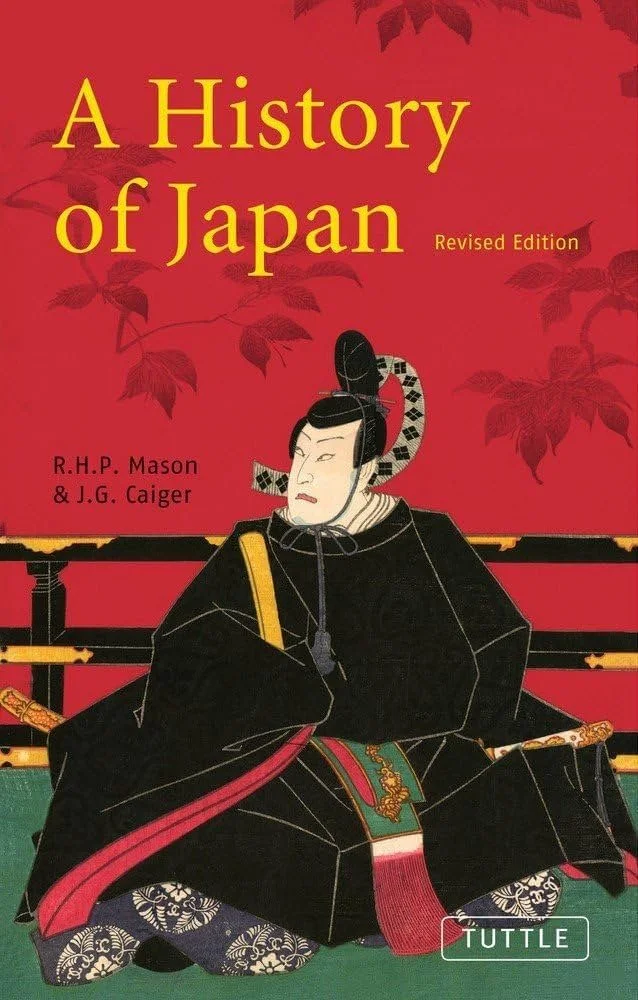
There’s something to be said about the grace and scale of a good history textbook. The ability to flexibly convey 2,000 years of history in a 350 page book without skimping on details or context is something not every writer or historian has. In my experience, you need a certain level of flexible density that allows the C student to pick up the gist while letting the A+ student drill down into minutae and it has to be the same book. This book, which comes from the Australia curriculum, recently updated into current day, does this perfectly and provides a layered, rich history of Japan that is just the right length for casual reading.
Japan has always interested, not as much perhaps as many people, but I have a lot of respect for their civilization. When it comes to their history, I know some of the highlights: Shogun, the Russo-Japanese War, WWII and of course, Godzilla. But that’s a very Americanized understanding and I wanted something deeperate and more comprehensive. Enter R.H.P. Mason and J.G. Caiger.
We start at about the best starting place we can, around 200 B.C. At this point, many of our records are simply accounts written by the older more advanced Chinese and Korean civilizations, who found the Japanese to be a strange and still primitive people, but not without some interesting hallmarks of what they would later become. There were more elegant aspects of community present than perhaps among other primitive indigenous people, such as a rudimentary system for organizing diplomacy with the aforementioned mainland states (such as sending the dirtiest man in the village overseas), as well as early cultural elements such as pottery and agriculture.
In the West, often think of civilized nations as “Westernizing” to get to where they are, to get into a context with which we are familiar with. Obviously, Japan did eventaully Westernize, but to even get to that point, they had to “Easternize”, in the style of Ancient China, an undertaking which took place during the reign of the beloved Prince Shotoku. Prince Shotoku was a sensible man who saw the relative prosperity of China and seemed to have a greater sense that he lived in a civilization which could actively develop. So he quite literally copy-pasted their system of government into Japan and boom!- Japan the nation began to emerge from the primordial stew of Japan the maritime civilization.
From there the book establishes it’s structure, where we get a chapter or two of linear history followed by cultural history and/or religious history, sometimes divided into chapters about specific art forms like music and art or specific religious movements like Buddhism. There’s a lot about Buddhism in here, stuff I vaguely remembered from my Zen classes in college. I felt like these divisions could’ve been a little smoother at times and that in some areas it was more detail than I felt I needed, but I did enjoy learning about it. You can see the textbook vs pure narrative aspect showing here, as chapters of the book do seem to be more encapsulated/partitioned. It’s clearly built for a chapter/class structure. Nonetheless each chapter is informative, straightforward and well paced.
The linear history sections are very matter of fact readable history which deftly balance economic, social and governmental changes across the country’s history. The way the authors draw the strings of these various timelines into the broader quilt of Japanese history is very pleasant. The events described are carefully and richly built up to us with context that elaborates but does distract from the overall arc of each chapter. For example the chapter that contains the history featured in Shogun does a great job of using the excitement of that famous narrative as a vessel for a larger story of Japanese-European relations and Japan’s technological development.
The cultural chapters are very good as well, though admittedly I liked them less and felt their smaller scope worked against the strengths of the authors chapter structure. They do provide beautiful, thought provoking excerpts of Japanese literature and some helpful illustrations of cultural artifacts as well as some gorgeous art. The chapters function as they should and do contribute to the educational depth and density of the book, they’re just not favorite type of chapters. Even in school I thought the stories about the wars or exploration were more interesting than the chapters about the pots in the homes of the people fighting in the war.
The religion chapters, especially one that in the middle-ish, are very dense for a casual reader and could almost serve as an introduction to Buddhism. As I mentioned above, I learned some of what is discussed in a college class and they do get pretty into it for a textbook that is not about Buddhism. I could honestly even say that if you really want to- you could skip that second religious hapter, or feel okay about skimming it, because as enlightening as it is, it’s not super necessary to understand for the rest of the book. I think it’s awkwardly placed and should’ve been condensed, because right after you finish it, Buddhism actually becomes a little less central to overarching events. So you absorb all of this information to never see it have a big payof. It’s as engaging structurally as it could be.
While I do have my minor critiques, this book does many things well and I loved when it really got into more contemporary history. The chapters that cover the modern Japanese era- roughly from the Meiji Restoration until the end of the book, are some of the best in the book. This book is at it’s strongest when it can be broad and the fact that we don’t have or need hundreds of years of retrospection on these eras means that that Mason and Caiger can just move through time. There’s no need to paint a picture of the world and as such, these chapters feel faster and more urgent in their style and pace, which synergizes well with the action packed era in which it takes place.
As far as knowledge itself goes, I think I learned a lot from this book and that it serves as a solid foundation of history. As far as enjoyment goes, I found that to be sufficient as well. If you’re really interested in the history of Japan, this would be a good book for you. If you’re not, I find it interesting that you read this review.